
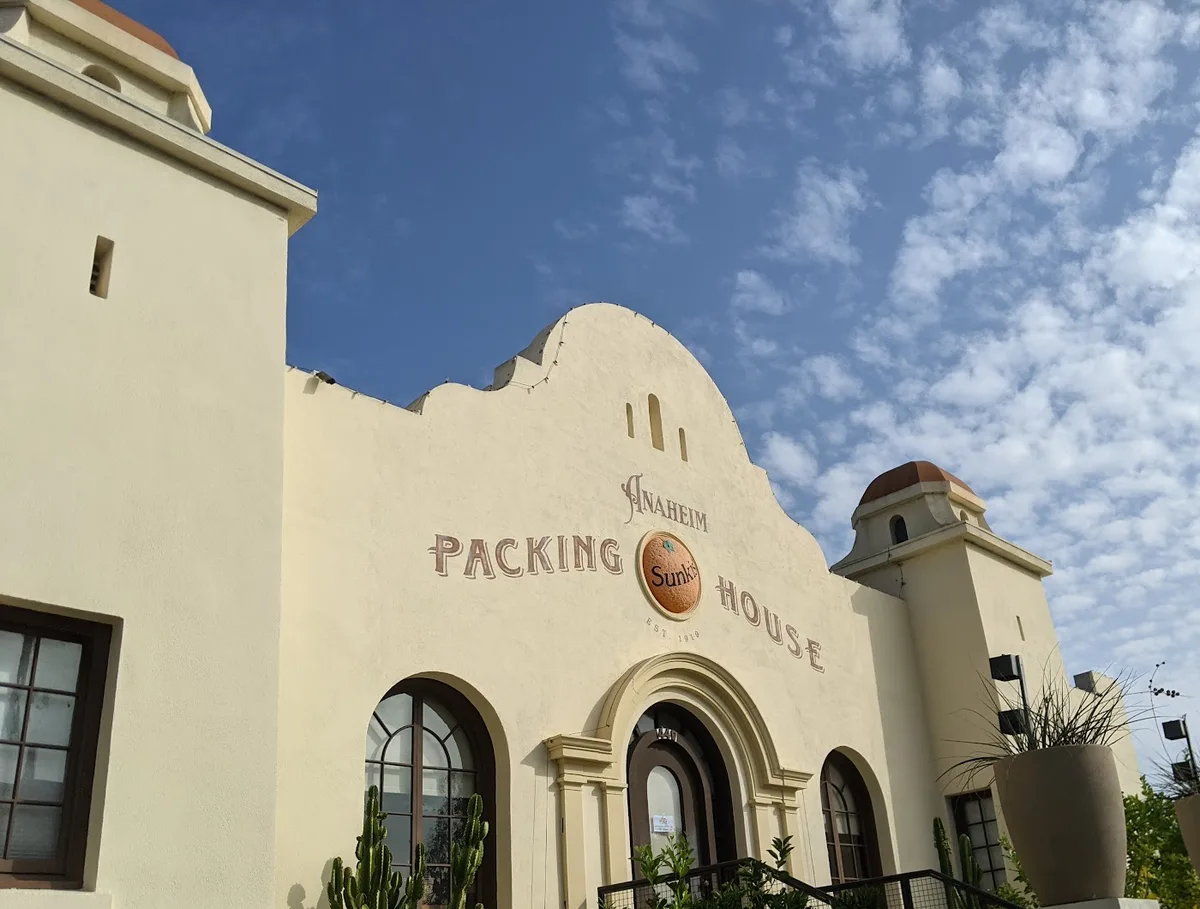

Start with the façade
The Anaheim Packing House makes its earlier purpose visible before you step inside. The name across the façade and the citrus emblem give the building a specific identity. In the photograph, the curved central parapet and arched openings frame that identity rather than disappearing behind a modern storefront. Looking closely at those elements is a useful introduction to the Packing District: a place where an existing building has been given another working life.
The district’s official visitor guide describes the Packing House as a former orange-packaging facility from 1919, now used as a two-story food hall. It places the building within a larger collection that includes MAKE, Farmers Park and the Packard Building. The Packing House and the Packing District are therefore related but not identical names. One is a particular building; the other describes the surrounding collection of places.
A history of changing work
The historic-places guide hosted by the district explains that the Anaheim Orange & Lemon Association opened the packing house in 1919. Its account describes equipment that moved fruit through the building, connecting the architecture to the practical work it originally supported. The Mission Revival exterior was not merely a decorative shell for today’s dining use; it belonged to a facility organized around handling and shipping produce.
The guide records the association’s closure of the packing operation in 1955 and a later period of industrial use. Reading that sequence helps avoid a simplified story in which a citrus warehouse jumped directly into its present identity. Buildings can pass through several purposes, and each period raises different questions about what to retain, adapt or remove.
For a visitor, the value of that history is not a list of dates to memorize. It is an invitation to notice what the building still communicates. Compare the broad exterior, the marked entrance and the rhythm of the openings with the needs of a shared food hall. The setting can be appreciated as architecture as well as a destination for a meal.
Make room for a flexible visit
Consult the district’s current merchant directory before choosing a specific stop. Its visitor information directs people to individual establishments for their hours. That is more useful than assuming every business follows an identical schedule. If your group has different priorities, decide what is essential and what can stay flexible.
Keep current practical rules with the operator’s visitor page. This article is not a reservation system, a merchant recommendation or an assurance that a particular business will be open. The photograph is editorial context and does not imply that the district or its merchants endorse this insurance site.
Separate the structure from what is inside
A building with changing uses is a natural prompt to distinguish a structure from the belongings inside it. The California Department of Insurance explains that residential policies separate dwelling and personal-property protection, while condominium responsibilities also depend on association documents. Those distinctions belong in a household insurance review even though a commercial food hall follows different arrangements.
Ask what you own, what another party maintains and which contract addresses each responsibility. Do not infer your home’s coverage from this landmark or its history. The issued policy and endorsements control, and an agent should review your actual property and use rather than substitute a neighborhood story for an insurance assessment.